What Dolby Atmos Actually Means in a luxury home theater
There's a conversation I have almost every week. Someone calls, tells me they want Dolby Atmos, and asks which receiver to buy. My answer is always the same: the receiver is the last thing we should be talking about.
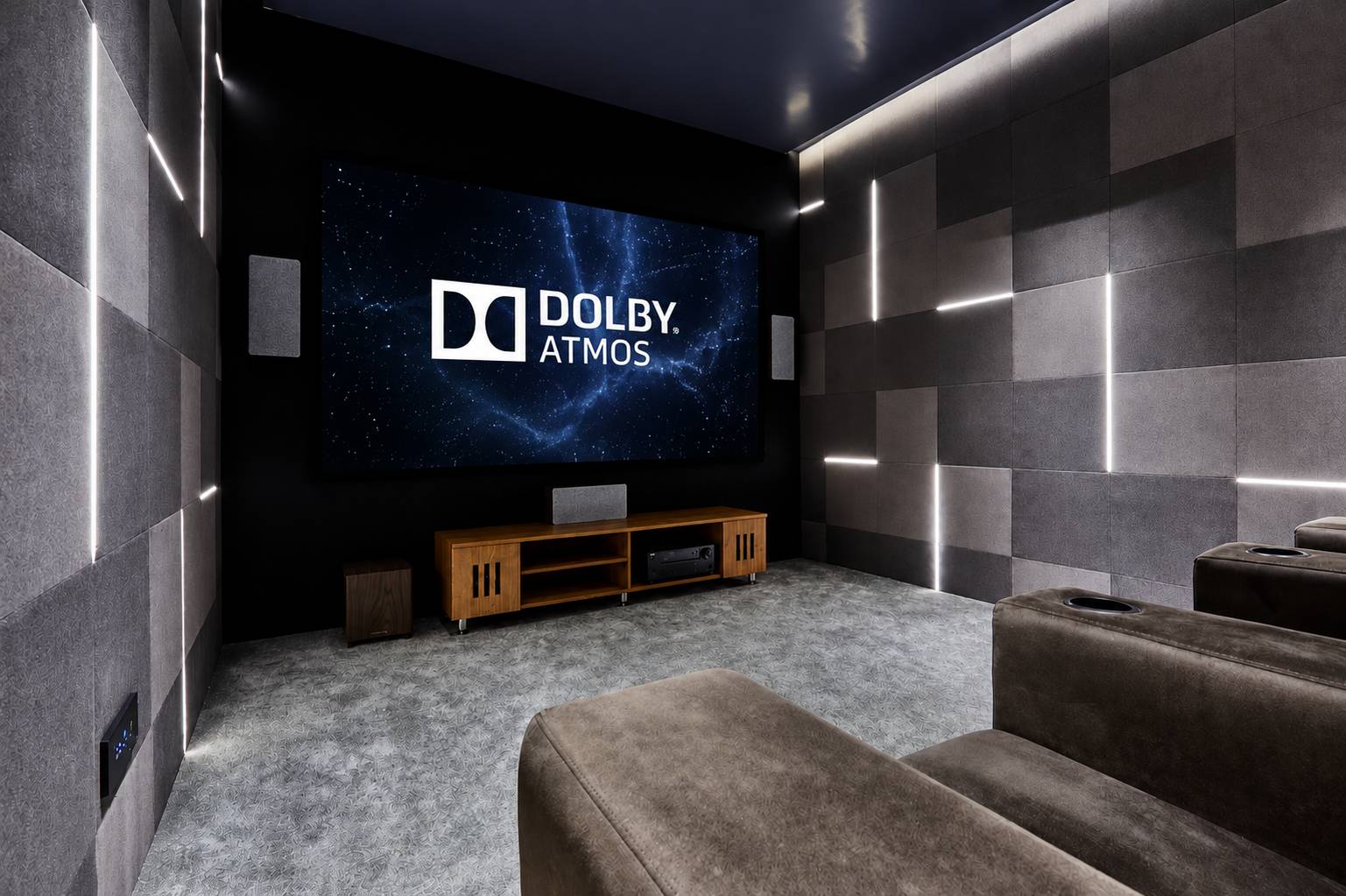
The biggest misconception
Dolby Atmos is not a speaker layout. It's not a receiver brand. It's not even a feature you can switch on.
Dolby Atmos is an audio format, specifically an object-based audio format. Understanding that one distinction changes everything about how you approach building a room for it.
From channels to objects
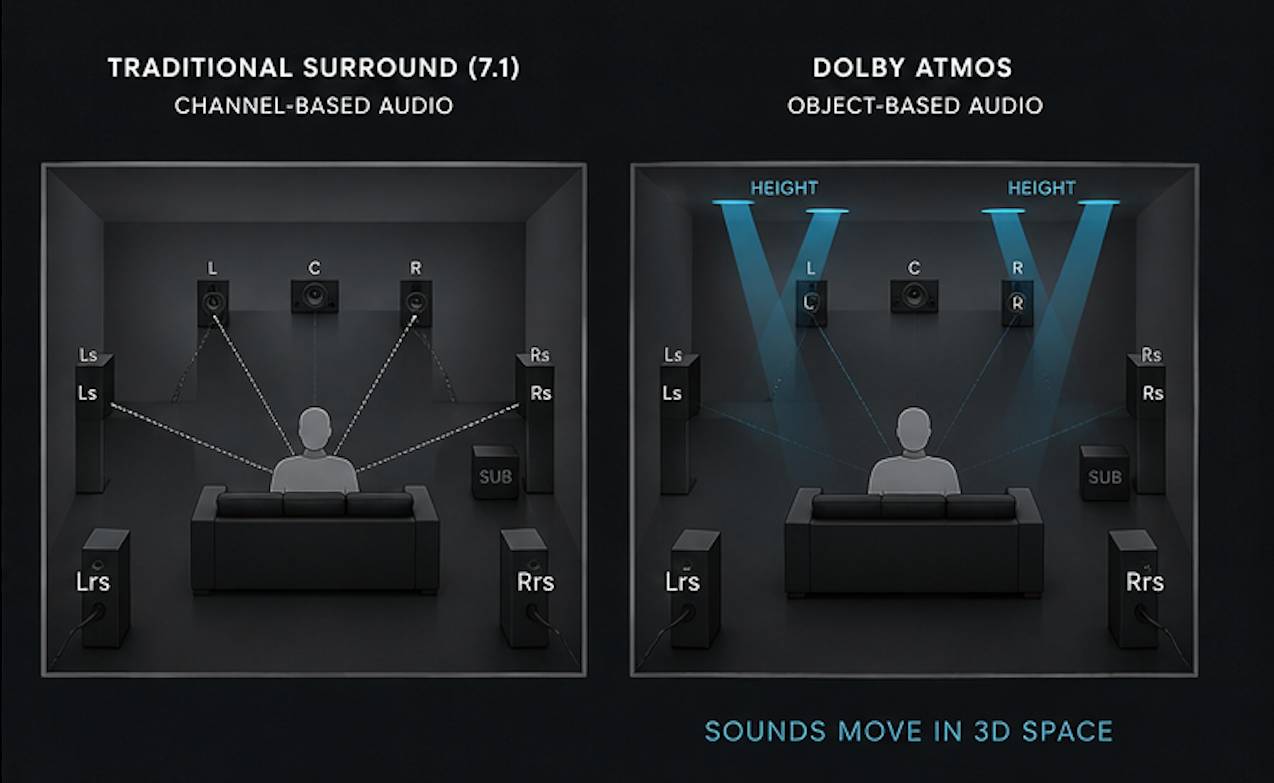
Traditional surround sound, 5.1, 7.1, works on channels. The mix engineer decides: this sound goes to the front left speaker. This one goes to the rear right. The sound is locked to that channel at the point of mixing. When it reaches your room, it plays from that speaker and nowhere else.
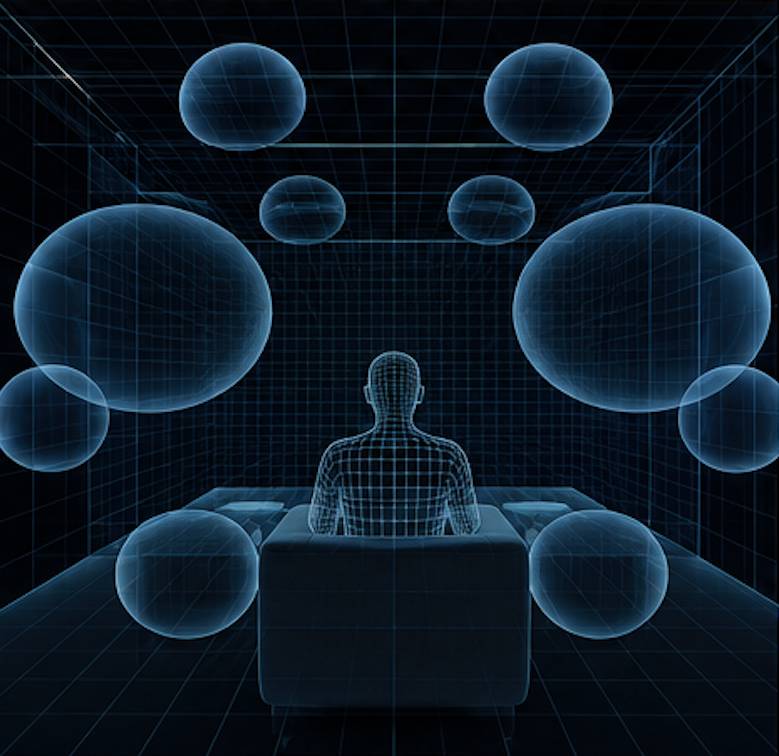
Dolby Atmos works differently. Instead of channels, it uses audio objects, individual sounds, each with its own positional metadata describing where it should exist in three-dimensional space. A raindrop doesn't go to a channel. It has coordinates: x, y, z. Height included. The Atmos renderer in your processor reads those coordinates and decides, based on the speakers you have and where they are, how to recreate that position as accurately as possible.
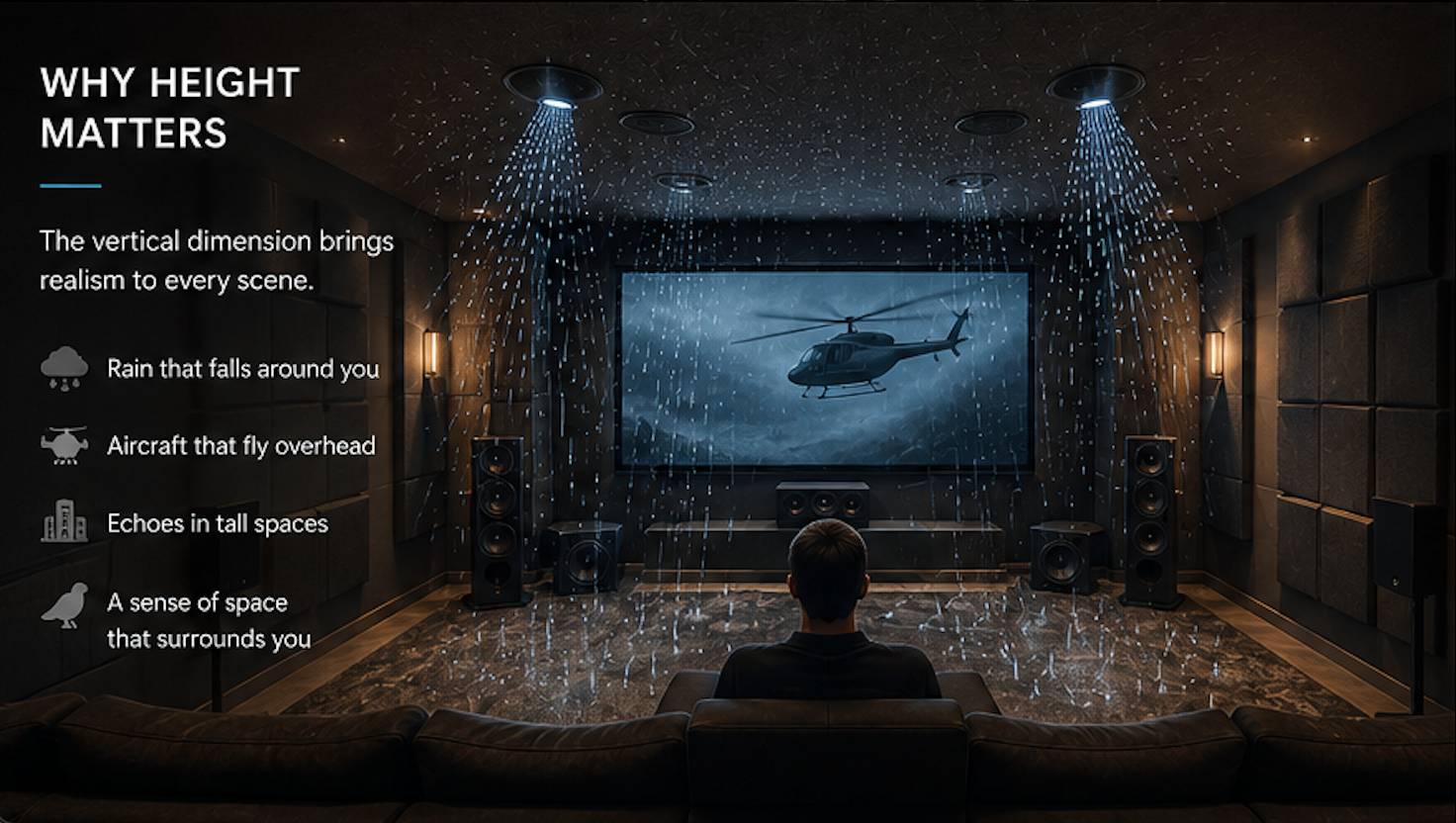
This is why a helicopter overhead in a properly executed Atmos room doesn't just pan from left to right. It actually moves above you, tracks across the ceiling, and fades behind you. Not because a sound designer routed it that way, because the format knows where it is in space and renders it accordingly.
Why height matters and why it's harder than it looks
The vertical dimension is what makes Atmos fundamentally different from everything that came before it. Rain, aircraft, echoes off tall buildings, the ambiance of a cathedral, these sounds have height. Stereo can't reproduce that. 7.1 can' reproduce that. Atmos can, if the room is built for it.
That last part is where most installations go wrong.
Ceiling speaker placement is not arbitrary. The angle of incidence from ceiling speaker to ear determines whether that overhead sound feels genuinely above you or just slightly elevated. Dolby publishes placement guidelines. Most installers don't follow them with any precision. A ceiling speaker positioned two feet off-spec creates a subtly wrong spatial image that your brain registers as something being not quite right, even if you can't articulate why.
The room is the instrument
Here's what nobody tells you when you're shopping for an Atmos receiver: the same Atmos soundtrack can sound dramatically different in two rooms with identical equipment. The room itself is part of the playback chain.
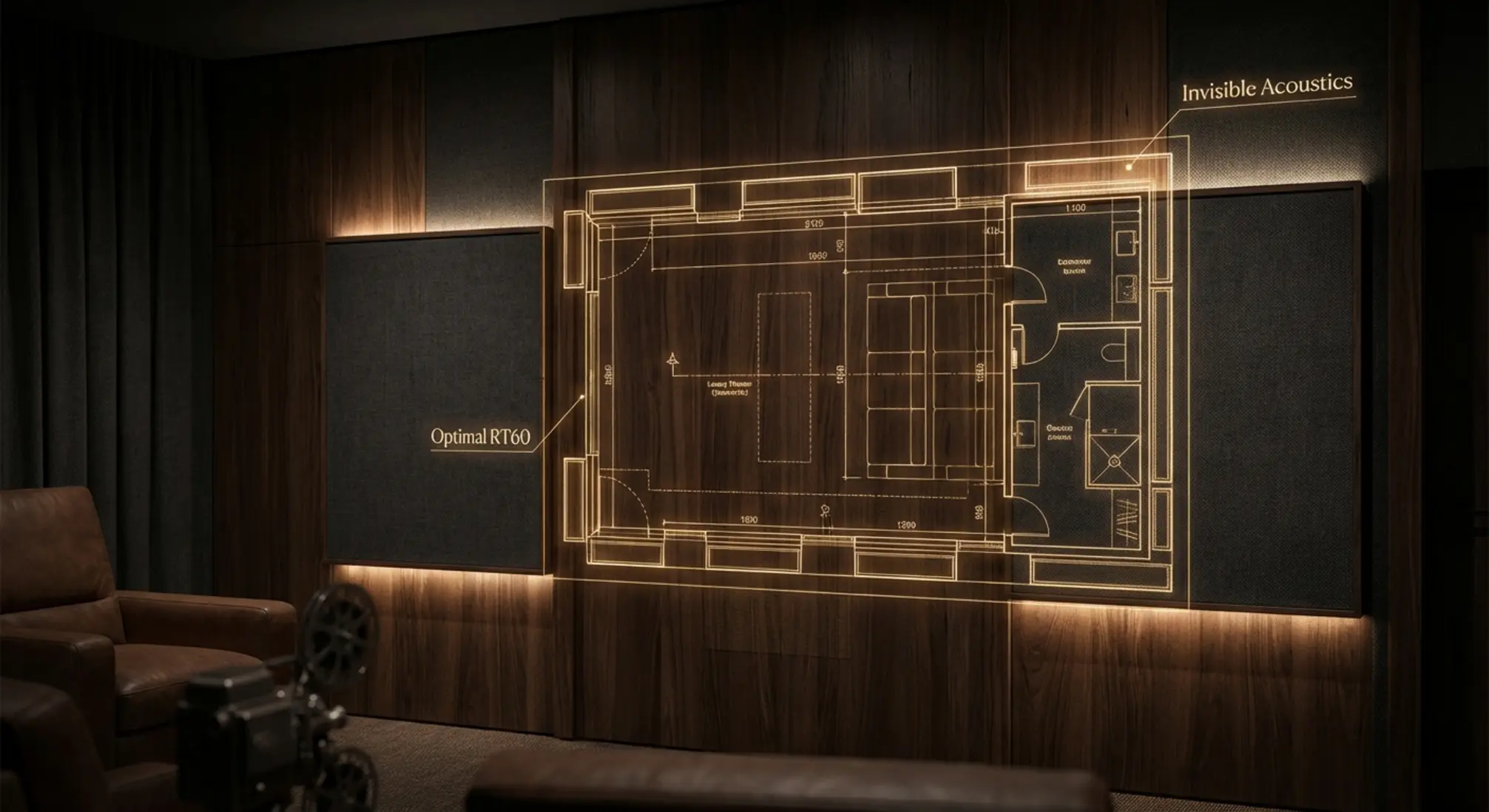
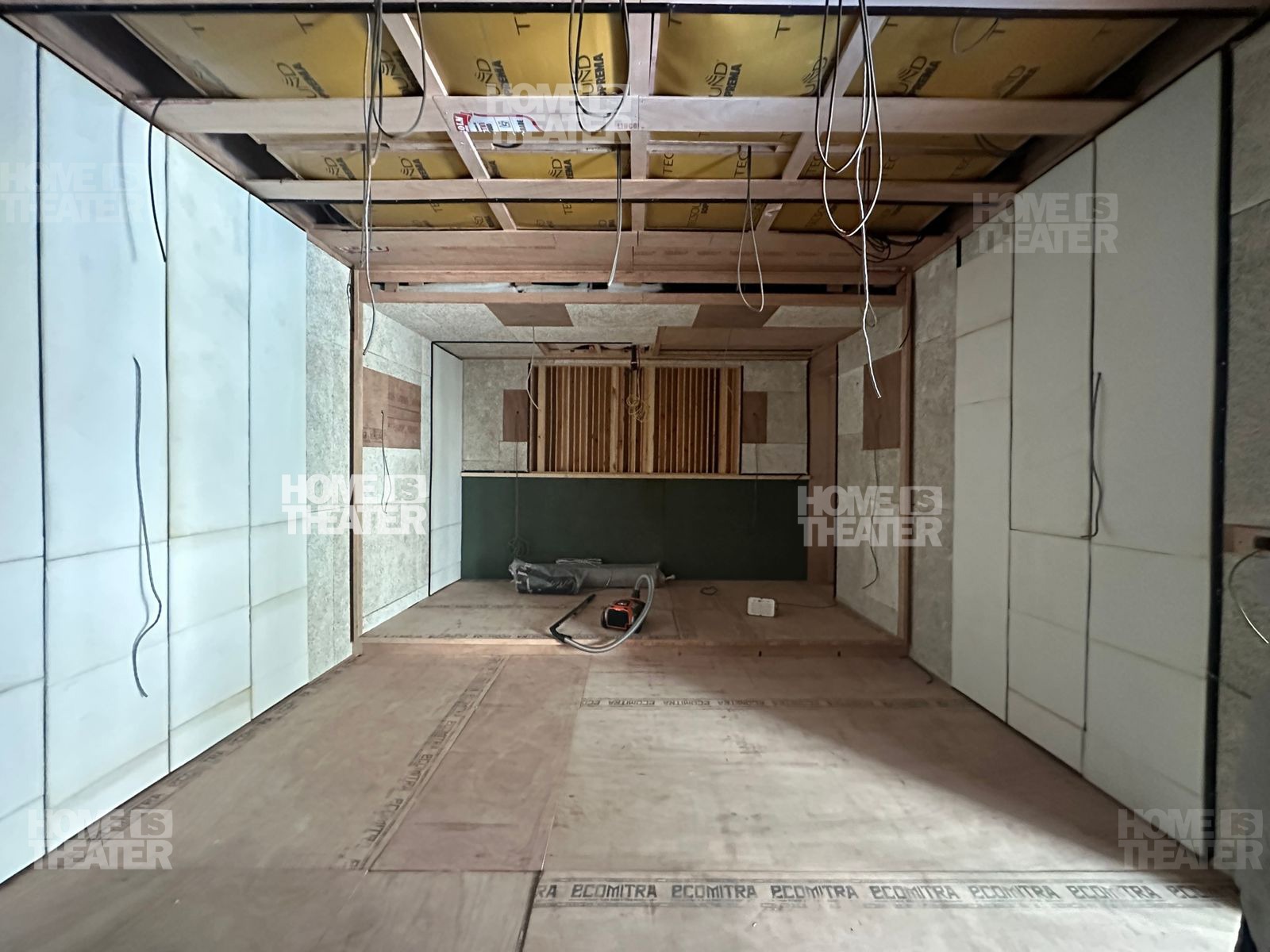
A room with parallel walls and no acoustic treatment will have flutter echoes. Bass modes will build up at specific points in the room, some seats will have too much bass, others too little. High-frequency reflections will smear the precise imaging that Atmos depends on. The overhead channels will blend into the room reverb rather than sitting cleanly above you.
Acoustic treatment doesn't just make a room quieter. It defines the precision with which the Atmos renderer can place sounds in space. Without it, you're trying to draw a fine line on wet paper.
Common mistakes and they're expensive ones
Upward-firing Atmos modules instead of ceiling speakers. These work by bouncing sound off the ceiling. The problem is that your ceiling is not an acoustically neutral reflector. Its material, height, and angle all affect what comes back down. Ina properly treated room with adequate ceiling height, dedicated in-ceiling speakers will always outperform modules. Always.
Mixing speaker brands and timbres. Atmos works because the renderer assumes consistency across the speaker array. When your front LCR is one brand, your surrounds are another, and your ceiling speakers are a third, the timbral mismatch is audible. Sounds don't blend seamlessly as they move through space. They change character as they cross from one zone to another.
Buying more speakers before improving the room. Nine speakers in a bad room will under perform five speakers in a good one. Every time.
Skipping calibration. Atmos calibration is not just level matching. A proper Atmos calibration, done with measurement software and adjusted by ear, sets the distance, delay, crossover points, and level of every speaker relative to every other speaker in the room. Without it, the renderer is working with incorrect assumptions about your setup.
How many speakers do you actually need?
The minimum viable Atmos configuration is 5.1.2, five speakers, one sub woofer, two ceiling speakers. It works. You get the height dimension and basic object movement.
5.1.4 adds two more ceiling speakers and significantly improves the precision of overhead placement. Front-to-back movement above you becomes much more convincing.
7.1.4 is where most dedicated cinema rooms should land. Seven speakers at ear level, four ceiling speakers, one sub woofer. Wide enough to envelop you. Precise enough to track object movement convincingly in all directions.
9.1.6 and beyond is for rooms where the dimensions justify it, typically 20 feet or longer. More speakers in a smaller room doesn't improve the experience. It creates phase problems.
The honest answer is: the configuration that suits your room. Not the one with the most channels.
Is Atmos worth it?
Yes, but only if the room is ready for it.
A well-designed 7.1 room with proper acoustic treatment, correctly placed and calibrated speakers, will outperform a 7.1.4 Atmos installation where the room hasn't been considered. This is not a theoretical statement. Across our projects in Bangalore, Hyderabad, Bagalkot, Hubli, Davangere and Raichur, I've heard both.
What Atmos gives you, when everything else is right, is a sense of being inside the sound track rather than sitting in front of it. Rain that falls around you, not just near you. A score that occupies the full volume of the room. Dialogue that sits exactly where the actor is on screen regardless of where you're sitting.
That experienceis real. But it doesn't come from the receiver, or the speaker count, or the Atmos logo on the box.
Spatial music,what's coming next
Atmos was built for cinema. But it's increasingly the format that music is being mixed in.
Apple Music,Amazon Music, and Tidal now carry thousands of tracks mixed in Dolby Atmos,reissues of classic albums, new releases from major artists, and live recordings mixed spatially from the ground up. When a well-mixed Atmos music track plays in a properly built room, the experience is not surround sound in the traditional sense. The instruments occupy positions in space. The room feels larger than it is. You're not listening to a recording of a performance,you're inside the acoustic space where it was captured.
This is where home cinema is going. The room built for film today will be the room that plays spatial music in a way no streaming service on headphones can approximate.
Dolby Atmos isn't something you buy. It's something you design.