Guide to Mastering Room Acoustics and Sound Behavior
Compare acoustic treatments and learn how to manage RT60, echoes, and standing waves. Discover the best solutions for home cinemas and commercial spaces today.

You stand at a critical juncture in your quest for superior sound, whether it's for a luxury home cinema, a high-stakes boardroom, or an immersive learning environment. You're past the initial "what is a home theater?" stage and deep into evaluating solutions. The question isn't just about the equipment anymore—it's about the very space you're building it in. How do you ensure your investment delivers the performance you expect? The answer lies in mastering the unseen architecture of sound: room acoustics.
At HomeIsTheater, we understand that true immersive audio is not an accident—it's engineered. It's about designing silence, harnessing reflections, and taming echoes. This guide will arm you with the principles and evaluation criteria you need to differentiate genuine acoustic excellence from mere equipment installation.
Decoding the Physics: How Sound Behaves in Your Space
Think of sound not just as something you hear, but as a physical wave moving through the air. Once these waves encounter the boundaries of an enclosed space—walls, ceilings, floors, furniture—their behavior becomes complex, shaping the final listening experience. Understanding this interaction is fundamental to evaluating any acoustic solution.
1. Reverberation: The Lingering Tail of Sound
Reverberation is the persistence of sound in an enclosed space after the original sound source has stopped. It’s created by a multitude of reflections bouncing off surfaces, gradually decaying as their energy is absorbed or dispersed. Too much reverberation makes speech unintelligible and music muddy; too little makes a room sound "dead" and unnatural.
A key metric we use to measure reverberation is RT60 (Reverberation Time 60 dB). This is the time it takes for sound to decay by 60 decibels after the source has stopped.
The Science of "Good" Sound: RT60 Targets by Room Type
Different spaces demand different RT60 values. Here's a brief evaluative framework:
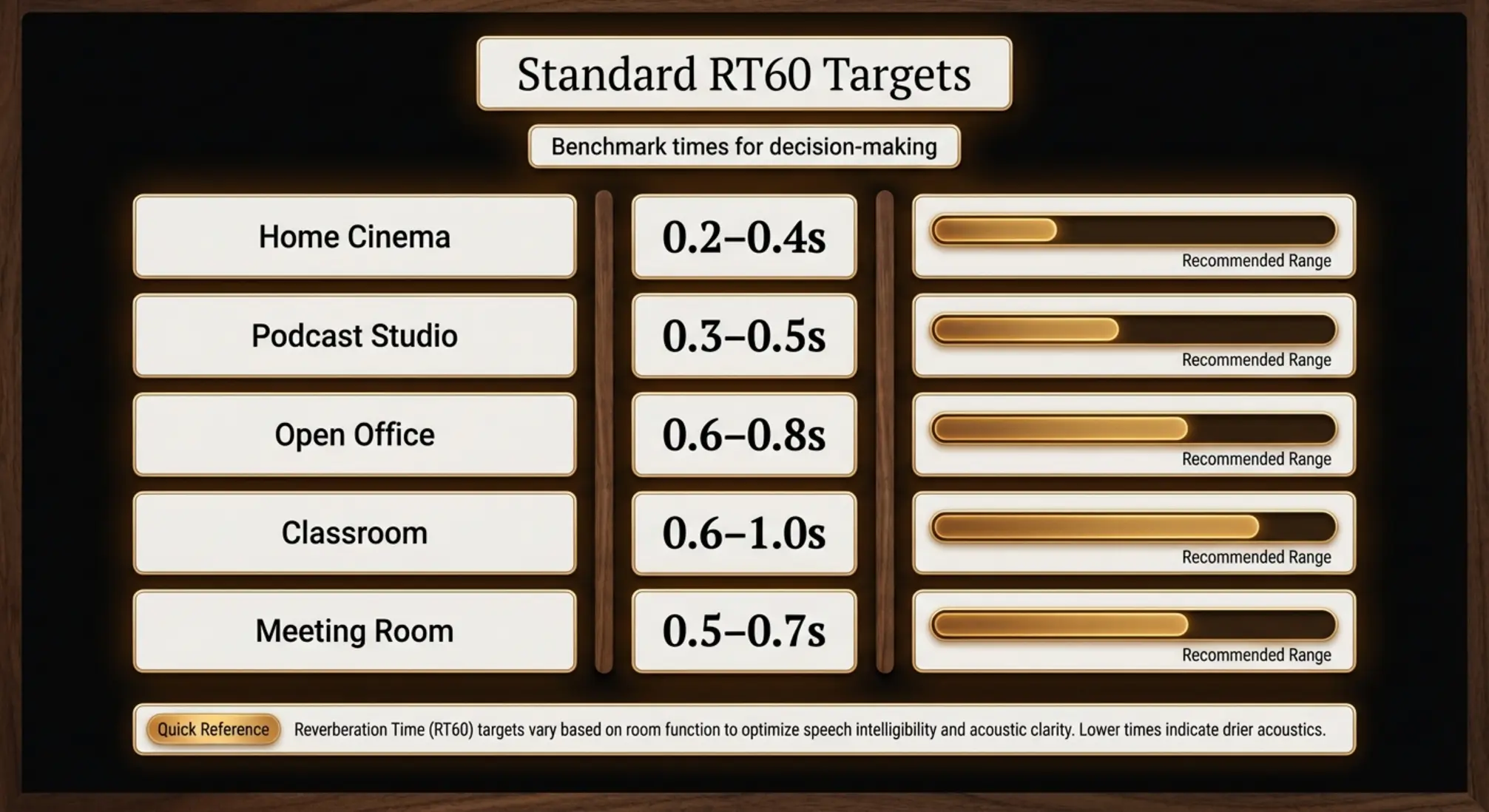
- Home Cinemas: Typically target 0.2–0.4 seconds. This range ensures clarity for dialogue and dynamic impact for soundtracks without sounding overly dry.
- Professional Podcast Studios: Even shorter, often less than 0.3 seconds, to achieve pristine voice recordings with minimal room coloration.
- Conference Rooms/Boardrooms: Aim for 0.5–0.8 seconds for optimal speech intelligibility. Longer times lead to communication breakdowns.
- Lecture Halls/Auditoriums: Can range from 0.8–1.2 seconds, depending on size and intended use (speech vs. music).
- Open-Plan Offices: While complex, managing reverberation is crucial. Excess noise contributes to a staggering 66% loss in productivity for workers exposed to nearby conversations. Effective acoustic treatment here can mitigate this.
When evaluating a solution, ask about their proposed RT60 targets for your specific room type and how they plan to achieve them. This demonstrates their understanding of performance benchmarking.
2. Echoes: Distinct Delays That Distract
While reverberation is many reflections blending together, an echo is a distinct, discernible repetition of a sound. This occurs when a sound wave travels to a distant surface and reflects back to the listener with a delay of at least 50 milliseconds. Common culprits are large, parallel, hard surfaces in bigger rooms. Echoes are highly disruptive and must be eliminated for a truly immersive experience.
One particularly harsh form is flutter echo, a rapid succession of echoes between two parallel reflective surfaces, creating a metallic, ringing sound.
3. Standing Waves (Room Modes): The Bass Blight
Low-frequency sounds (bass) behave differently than high frequencies. In enclosed spaces, particular bass frequencies can resonate, creating what are known as standing waves or room modes. These are specific frequencies whose wavelengths perfectly align with the dimensions of the room. The result? Certain areas of your room have exaggerated bass (pressure maxima), while others experience severe bass cancellation (pressure minima). This makes bass seem muddy or boomy in some spots and completely missing in others.
This phenomenon is why your bass might sound great in one chair, but thin just a foot away. It’s a core reason why two receivers in a room with identical speakers can sound vastly different—the room itself is the primary variable.
The Math of Your Room: Calculating Axial Modes
To effectively treat standing waves, you need to identify them. The simplest forms are axial modes, which occur between two parallel surfaces (length, width, height). An acoustic expert will calculate these based on your room dimensions.
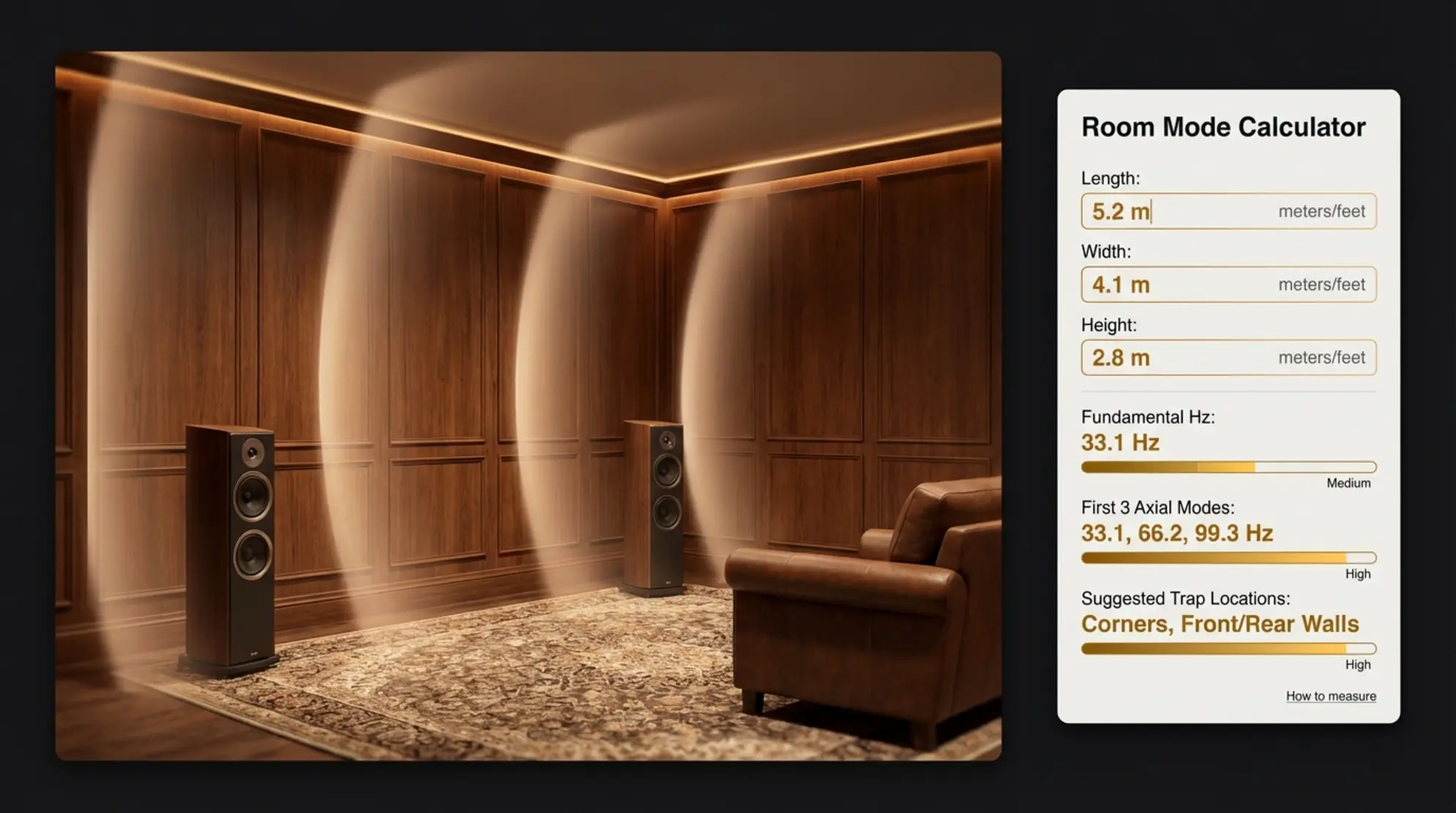
At HomeIsTheater, we use precise calculations to map these modes. While a full interactive calculator is being developed, understanding these principles allows you to appreciate the depth of a truly engineered solution. Experts consider not just axial, but also tangential (between four surfaces) and oblique (between all six surfaces) modes for truly optimal bass response. The "38% Rule" often cited in audio circles, suggesting the optimal listening position is 38% of the way into the room from the front wall, is an oversimplification but highlights the importance of listener placement relative to these modes for better frequency response.
4. Sound Reflection and Diffusion: Shaping the Soundscape
Once sounds leave your speakers, they don't just disappear. They hit surfaces.
- Reflection: When sound waves hit a hard, flat surface, they bounce off at an angle equal to their approach angle. These early reflections, if uncontrolled, can interfere with the direct sound from your speakers, collapsing the soundstage and blurring detail. This is where Designing Silence: Why Acoustics Make or Break Your Home Theater comes into play.
- Absorption: Absorptive materials convert sound energy into heat. Materials like specialized acoustic panels, carpets, and heavy curtains absorb sound, reducing reflections and reverberation. Aerogel, for example, offers 2-4x better insulation per inch than glass wool, though it's significantly more expensive, showcasing the vast range in material efficacy.
- Diffusion: Diffusers scatter sound waves in multiple directions, rather than just absorbing them or reflecting them specularly (like a mirror). This maintains the "liveliness" of a room while preventing echoes and flutter, creating a more open, spacious, and natural soundstage. Diffusion is crucial for maintaining a sense of realism without making a room sound too "dead."
Choosing the right balance of these acoustic treatments is an art and a science—it's essential for a truly immersive and fatigue-free experience.
DIY vs. Professional: Your Evaluation Framework for Acoustic Treatment
This is often where the economic justification intent comes into play. Is the additional investment in professional acoustic treatment truly worth it?
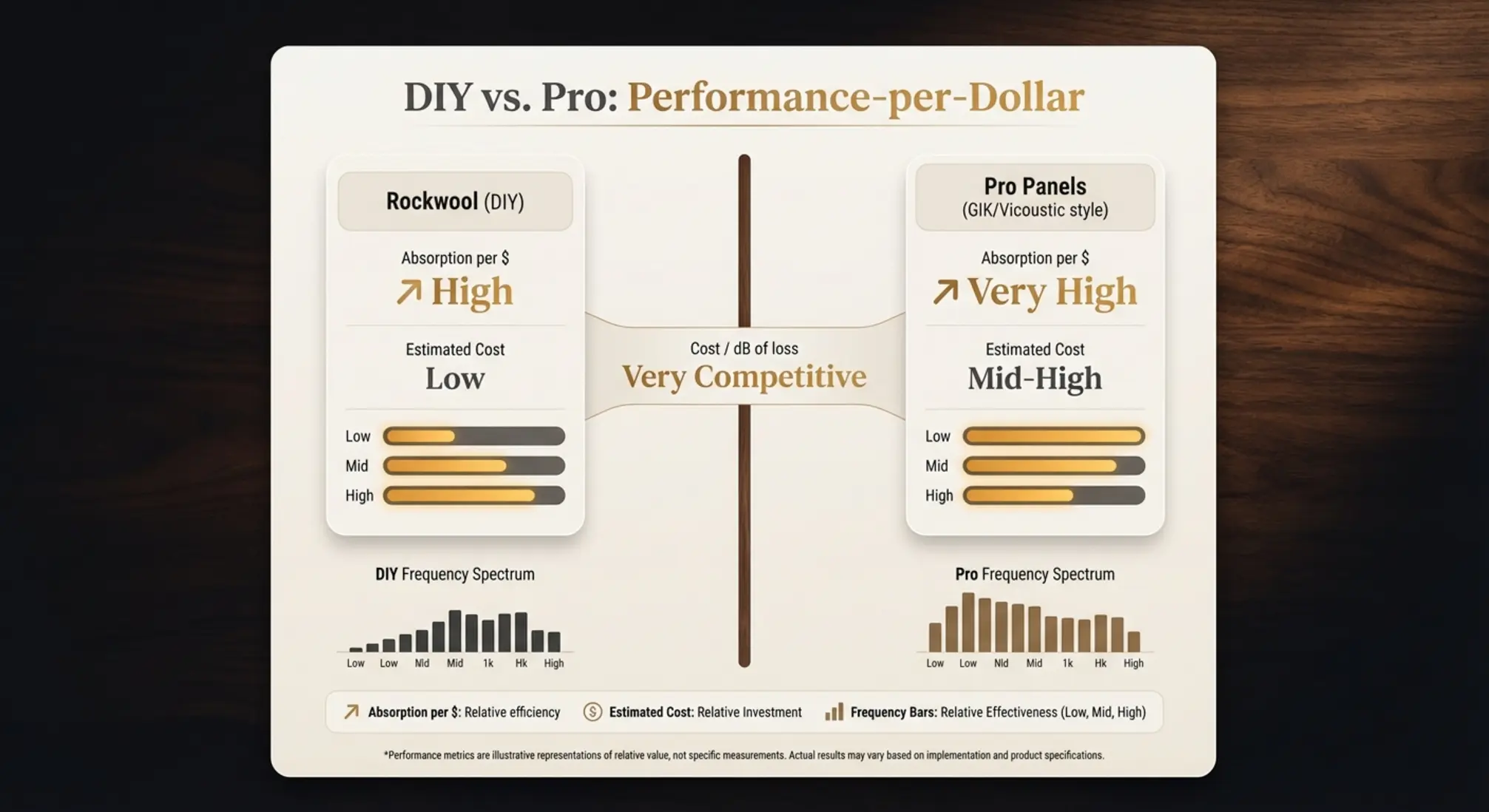
Many users on forums like Gearspace and Reddit debate the merits of DIY solutions (like Rockwool panels) versus professional options (like GIK Acoustics or Vicoustic). While DIY can offer a marginal improvement, the "performance-per-dollar" curve often favors professional, scientifically designed solutions with precision installation, especially for high-end environments.

For a luxury home theater, professional environments, or educational spaces, the precision and aesthetic integration offered by experts like HomeIsTheater are non-negotiable. This isn't just about sticking foam on walls; it's about meticulous planning, detailed circuit blueprints, and an understanding of The perfect home theatre project from foundation to calibration.
Psychoacoustics: How Your Brain Perceives Sound
Beyond the physics, there's psychology. How your brain interprets these sound waves profoundly impacts your experience. The clarity of dialogue in a home cinema, the engagement of a presentation in a boardroom, or even the cognitive load in an open office are all influenced by acoustic conditions.
- In a luxury home cinema, poor acoustics can lead to listening fatigue, distracting from the narrative and diminishing the "escape" factor.
- In corporate settings, sound masking systems can significantly reduce distractions and improve focus, especially in spaces needing HIPAA-compliant privacy or just general noise reduction.
- For educational institutions, clear sound ensures that every student can understand the lecturer, directly impacting learning outcomes.
Why Precision Acoustics Matter (and How to Evaluate It)
For High Net-Worth Individuals (HNIs) in cities like Bangalore, Delhi, Mumbai, or Hyderabad, investing in a luxury home theater or advanced home automation means expecting an experience that surpasses commercial venues. Similarly, for corporations and educational institutions, AV solutions must enhance productivity and communication.
- No Templates, No Off-the-Shelf Bundles: Just as you wouldn't accept a template for your architectural masterpiece, acoustic design demands a bespoke approach. Every room is unique, with distinct dimensions, materials, and potential acoustic issues. Solutions must be tailored.
- Expert Knowledge: Vishwas, our founder, brings extensive knowledge in sound design and experiential audio. Our team has over 50 collective years of professional AV design, execution, and integration experience. This expertise allows us to transform complex research into accessible, actionable insights. Don't settle for less than this level of profound understanding.
- Holistic Integration: Acoustics aren't isolated. They must be integrated seamlessly with layout, lighting, and power design. A truly great home theater or commercial AV system is a symphony of these elements.
- Demonstrable Results: The best way to evaluate an acoustic solution is to experience it. Visiting our Bangalore demo room provides a firsthand encounter with engineered sound, allowing you to validate the claims we make.
Your decision at this Middle-of-the-Funnel stage isn't just about choosing a vendor; it's about choosing a partner who can translate scientific principles into an unparalleled auditory experience. We invite you to explore our services for Home Theatre Design & Installation, Commercial Audiovisual Solutions, and Home Automation, and to reach out for a consultation. Let us show you how we engineer sound to create truly immersive environments.
Frequently Asked Questions about Room Acoustics
Q1: What makes a room acoustically "good"?
A: An acoustically "good" room balances sound absorption, reflection, and diffusion to achieve optimal clarity, intelligibility, and sonic balance for its intended purpose. This often translates to a controlled reverberation time (RT60), minimal distinct echoes, and an even bass response free from severe standing waves.
Q2: Can interior design elements double as acoustic treatment?
A: Absolutely. While dedicated acoustic panels are often necessary, many interior elements can contribute. Heavy drapes, plush carpeting, upholstered furniture, bookshelves filled with books, and even specific types of wall textures can all provide some level of sound absorption or diffusion. However, for precise acoustic control, integrating purpose-built acoustic materials during the design phase is crucial. This is why collaborating with architects and interior designers is key for us.
Q3: How important are acoustics compared to high-end audio equipment?
A: Acoustics are arguably more important than equipment for achieving superior sound quality in a room. Even the most expensive audio system will sound subpar in an acoustically untreated room, whereas a modest system can sound excellent in a well-treated space. The room itself is the largest component in your audio chain.
Q4: How do you measure the acoustics of a room?
A: Professional acoustic engineers use specialized microphones and software to conduct precise measurements, including RT60 values, frequency response, and impulse responses. These measurements help identify specific acoustic problems and guide the design of targeted treatments.
Q5: Is soundproofing the same as acoustic treatment?
A: No, they are different but related. Soundproofing aims to prevent sound from entering or leaving a space by blocking sound transmission (e.g., thicker walls, sealed doors). Acoustic treatment focuses on controlling sound within a space to improve its quality (e.g., reducing echoes, controlling reverberation). Both are essential for creating an optimal listening or working environment, but they solve different problems.
Q6: What's the biggest mistake people make regarding room acoustics?
A: The most common mistake is considering acoustics as an afterthought, rather than an integral part of the initial design phase. Retrofitting acoustic solutions can be more challenging and expensive, and may compromise aesthetics if not planned carefully. Integrating acoustic design from the ground up, in partnership with experts, ensures optimal performance and seamless aesthetic integration.