Electronic Room Correction & DSP Guide for Home Theater
Compare Dirac Live vs Audyssey and Trinnov. Learn how DSP and Parametric EQ refine spatial audio, restore bass impact, and optimize your luxury home theater.

You've invested in a luxury home theater, an immersive escape meticulously crafted for your discerning taste. Yet, even in the most thoughtfully designed spaces, the very physics of sound can introduce subtle imperfections. These are the nuances that separate a truly breathtaking cinematic experience from merely a good one. At HomeIsTheater, we understand that for High Net-Worth Individuals and institutions, "good enough" is simply not an option. This is where the unseen architect of sound, Electronic Room Correction (ERC) and Digital Signal Processing (DSP), steps in – refining your acoustic environment to perfection.
Many of our clients are actively evaluating how to bridge the gap between their high-end hardware and the reality of their room's acoustics. The journey often begins with questions like, "Is this expensive software truly worth it?" or "How can I regain the dynamic 'impact' that sometimes feels lost after calibration?" This guide is designed to empower you with the insights needed to confidently navigate these critical decisions, transforming your evaluation challenge into a clear path towards unparalleled audio fidelity.
Unveiling the Power of Digital Signal Processing in Bespoke Home Theaters
Imagine a concert hall where every seat offers the same pristine audio experience. This is the promise of advanced DSP, meticulously applied. Traditional acoustic treatments are crucial foundational elements, but even the best physical solutions can't fully compensate for every interaction between your speakers and the unique contours of your room. DSP technologies provide that final layer of digital refinement, correcting complex issues in real-time.
Our research shows a significant "technological arms race" in this domain, with legacy systems and cutting-edge solutions vying for superiority. The core challenge for many lies in the "complexity-value paradox": while the benefits of advanced DSP are clear, the technical implementation often seems daunting. Our goal is to demystify this process, guiding you through how these systems, from automated room correction software like Audyssey and Dirac Live to precise parametric EQ, ensure every sound is delivered as the artist intended.
The Great Debate: Audyssey vs. Dirac Live vs. Trinnov – What's Best for Your Sanctuary?
When clients approach us, they're often encountering the "X vs. Y" comparisons that dominate specialized audio forums. Deciding whether to invest in a $200-$500 Dirac Live license or opt for a Trinnov-enabled processor is a significant point of evaluation. Each system offers distinct advantages, aligning with different priorities and existing setups.
Audyssey, for instance, is often included in many AV receivers and provides a solid baseline correction, primarily focusing on the frequency domain, making it a good "low-volume usability" option. However, for the discerning listener who demands ultimate precision, especially above 500Hz, solutions like Dirac Live offer a tangible upgrade. Our research highlights that human hearing is most sensitive to phase and timing above this frequency, and Dirac excels here by correcting the time domain, which Audyssey largely overlooks (Simple Home Cinema Analysis). This means a more cohesive, impactful, and spatially accurate soundstage.
For the pinnacle of audio performance, especially in complex multi-channel and immersive audio setups, Trinnov processors stand in a league of their own. They offer unparalleled room optimization and 3D microphone spatial remapping logic, making them a professional luxury choice for the most demanding environments and those seeking the ultimate "bubble of sound" that Dolby Atmos and DTS:X promise.
Here's a snapshot to help you navigate this choice:
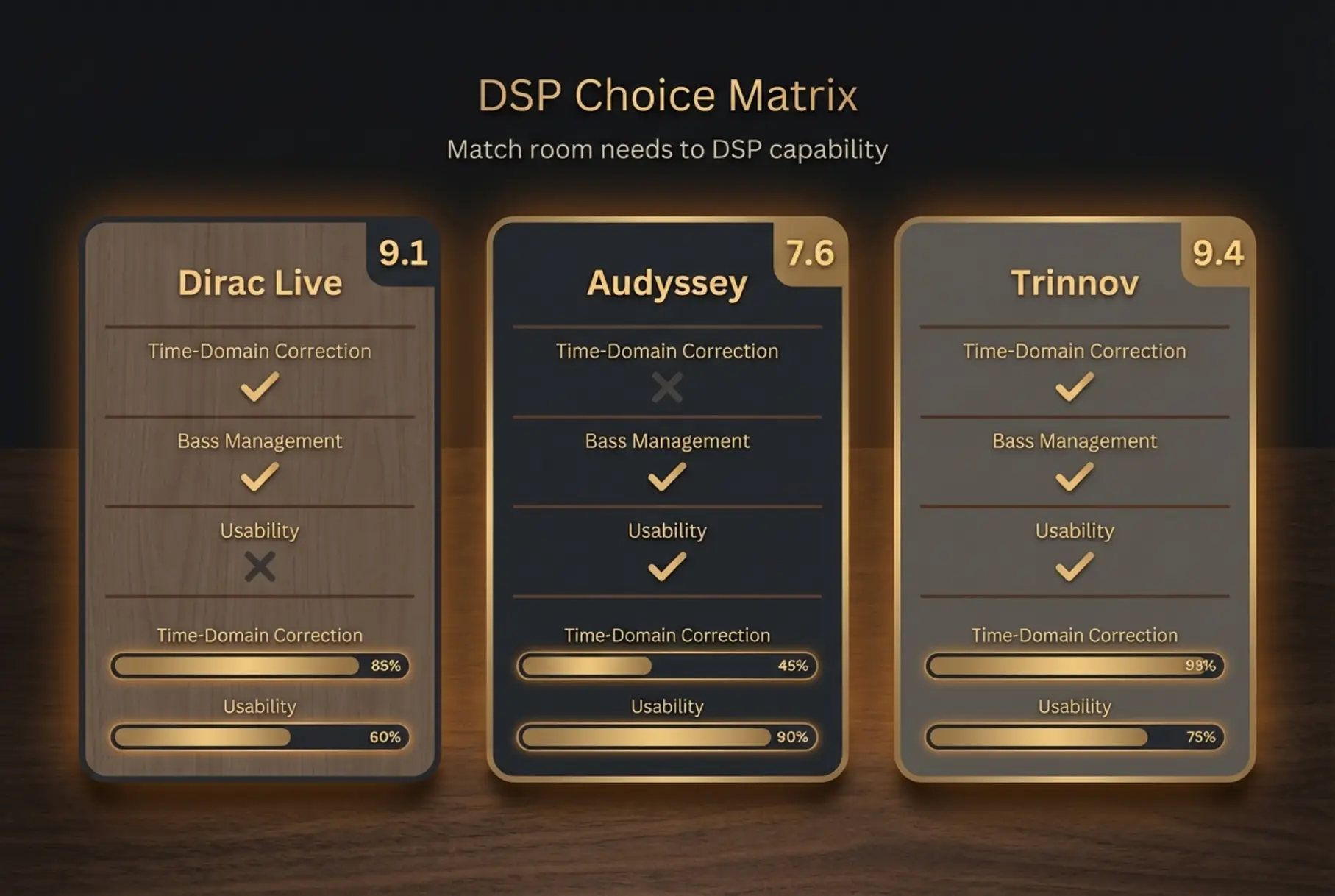
The decision often comes down to balancing sonic excellence, ease of use, and budget. For those whose goal is truly immersive audio beyond commercial cinema, the investment in advanced DSP like Dirac Live or a Trinnov often provides the most significant leap in perceived quality after the initial acoustic design.
Restoring Impact: Fixing What Room Correction "Breaks"
A common concern we encounter among enthusiasts (and a high-intent search topic on forums like ASR) is the complaint that after running automated room correction, the sound can sometimes feel "sterile" or lack the dynamic "impact" they crave, particularly in the bass. This is the "Impact Restoration Protocol" our clients often seek.
While automated systems are excellent at smoothing out frequency responses, they can sometimes inadvertently compress dynamics or alter the intended sound if not fine-tuned. The key is in understanding how to apply specific "Target Curves" and judiciously use features like Dynamic EQ.
Here’s a practical approach to regain that coveted dynamic punch post-calibration:
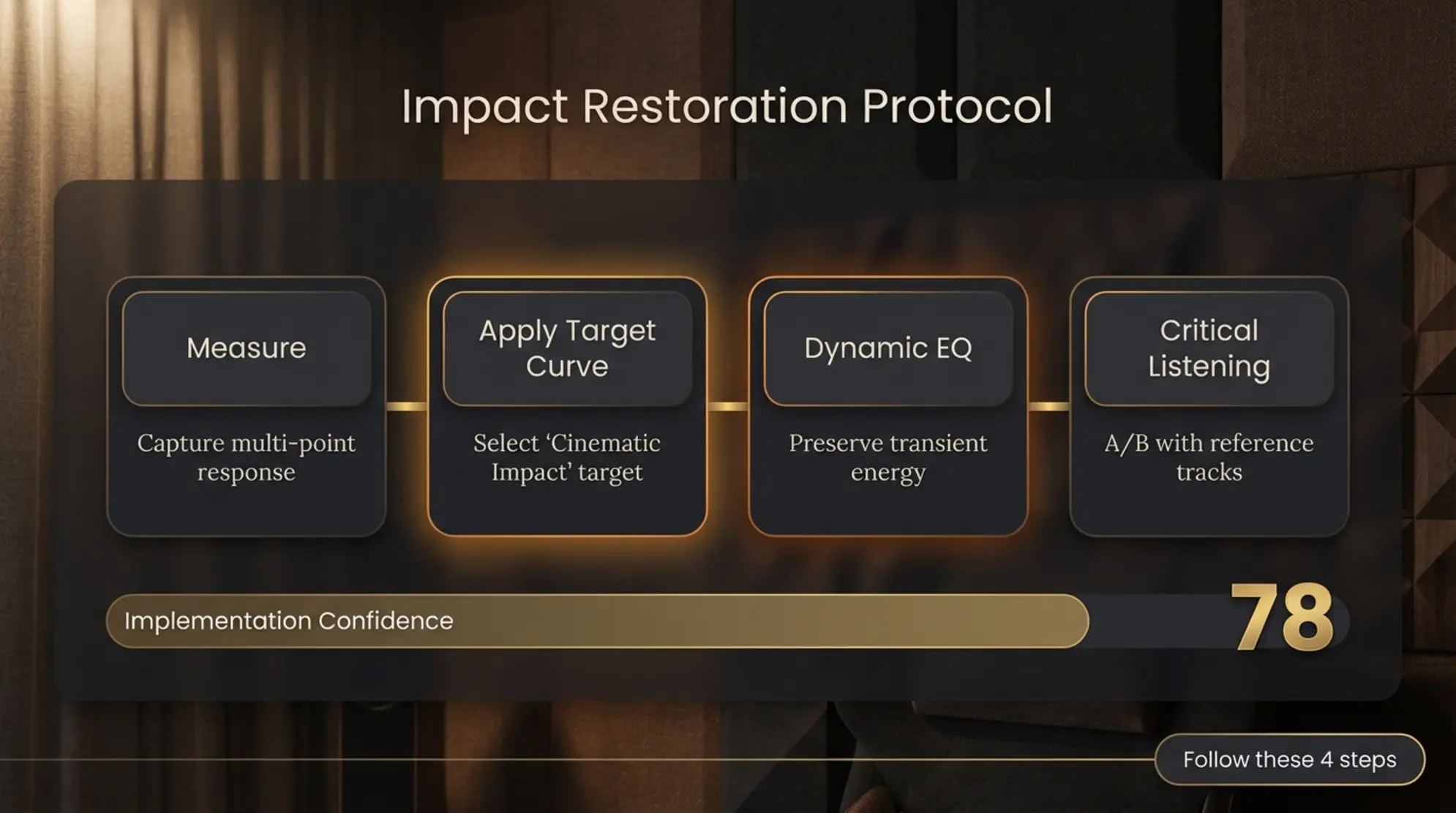
Implementing these steps transforms your automated calibration from a static endpoint into a strategic starting point, allowing you to tailor the sound to your ultimate preference. We often provide "Target Curve" templates, pre-modeled for "Cinematic Impact" vs. "Critical Listening," giving you a head start in achieving your desired sound signature.
The Surgeon's Scalpel: Parametric EQ for Taming Room Modes
Even with the most advanced automated room correction, some stubborn acoustic anomalies, particularly "room modes" (standing waves that cause certain frequencies to boom or disappear), might remain. Here, Parametric EQ (PEQ) becomes your "manual surgeon's tool", offering precision that broad-stroke auto-EQ might miss.
While some consider PEQ "old school," we see it as essential for detailed refinement. It allows you to select specific frequencies, adjust their gain (boost or cut), and—critically—control the "Q" factor, which determines how wide or narrow the affected frequency band is. This precision is invaluable for addressing specific, localized issues, particularly in the bass region.
At HomeIsTheater, our approach to Home Theatre Design & Installation integrates PEQ as a critical final tuning step. This ensures that even the most difficult room modes are tamed without affecting the broader frequency response.
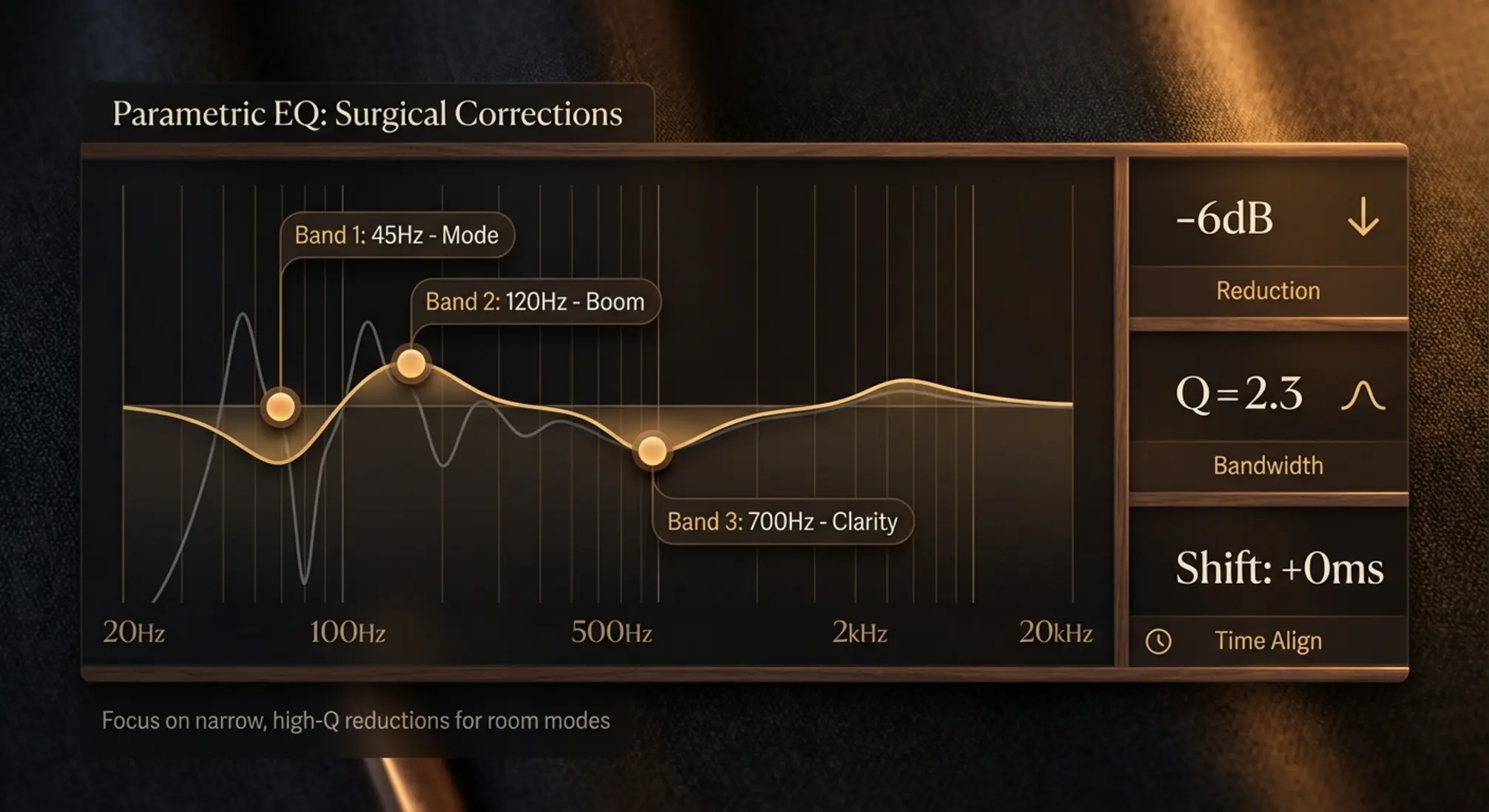
This level of detailed intervention is what truly defines a bespoke experience, allowing for a nuanced and fatigue-free acoustic environment.
The Spatial Audio Synergy: DSP for Dolby Atmos and DTS:X Immersion
The promise of Dolby Atmos and DTS:X is a truly three-dimensional "bubble of sound." But achieving this relies heavily on how well your DSP system understands and manipulates the interaction between your speakers, your room, and the intended 3D audio space.
Advanced DSP systems, especially those with 3D microphone arrays like Trinnov, actively map your room and speaker positions in three dimensions. This allows them to precisely re-map sound objects to their correct spatial locations, even if your physical speaker placement isn't absolutely ideal. This remapping logic is crucial for maintaining the illusion of height and depth.
Consider the complexity of managing multiple subwoofers for seamless bass integration. The "Bass Tax" of multi-subwoofer optimization (DLBC for Dirac Live) can be a financial point for many, highlighting the need for careful planning. Systems like Dirac ART (Active Room Treatment) are pushing the boundaries further, using multiple speakers to actively cancel out reflections, creating an even cleaner and more defined soundstage (Audioholics, 2023).
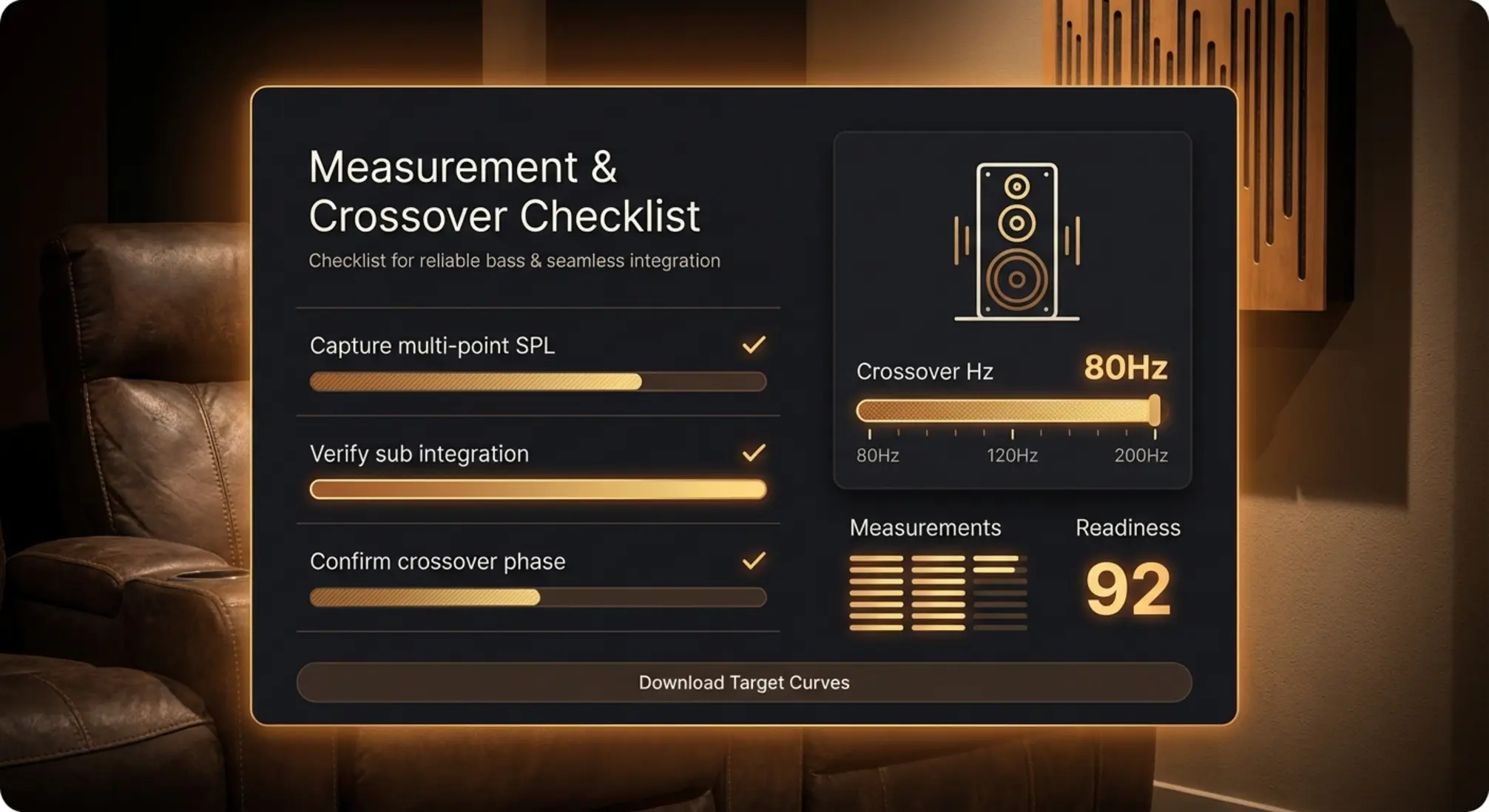
The precise management of crossovers, especially for height channels in an immersive setup, is another critical area where DSP shines. Optimizing these frequencies ensures a seamless blend between main and height speakers, preventing a disjointed sound field. Our internal "Crossover Calculator" helps determine ideal settings, taking into account factors like speaker type and room geometry.
FAQ: Your Most Pressing Questions on ERC and DSP
Q1: What's the fundamental difference between physical acoustic treatment and electronic room correction?A1: Physical acoustic treatment (panels, bass traps) prevents room issues by absorbing or diffusing sound waves. ERC/DSP corrects remaining issues digitally by manipulating the audio signal. Both are essential. Physical treatment provides the foundation; DSP provides the final, precise polish.
Q2: Can DSP truly replace dedicated acoustic panels and bass traps?A2: No. While DSP is incredibly powerful, it cannot fix severe acoustic problems (e.g., flutter echoes, excessively long reverberation times, or massive bass nullscaused by fundamental room dimensions) as effectively as physical treatments. Think of it this way: you can digitally EQ a bass room mode, but you might drain amplifier power trying to boost a deep null. Physical treatment solves the root cause; DSP refines the outcome.
Q3: Is professional calibration necessary if I use automated room correction software?A3: For a luxury home theater, absolutely. While automated systems provide a good starting point, a professional calibrator understands the nuances of target curves, speaker-level integration, bass management, and how to apply parametric EQ for optimal results. They also ensure consistency with the content creator's intent. HomeIsTheater offers expert Home Theatre Consultations in Bangalore, Delhi, Mumbai, and Hyderabad, providing this invaluable service.
Q4: How does DSP affect the overall sound quality or "musicality" of my system?A4: When implemented correctly, DSP enhances sound quality and musicality. By removing unwanted room interactions, it allows the true character of your speakers and recordings to shine through. Poorly implemented or overly aggressive DSP can indeed make a system sound "sterile" or "fatiguing," which is why professional expertise in setting target curves and understanding listener preferences is paramount.
Q5: What are FIR vs. IIR filters, and why does "Mixed Phase" matter for spatial imaging?A5: This gets technical, but in brief:
- IIR (Infinite Impulse Response) filters are common in many DSPs; they are computationally efficient but can introduce phase shifts.
- FIR (Finite Impulse Response) filters, used in advanced systems like Dirac Live and Trinnov, can correct phase issues more precisely without introducing new ones, but are more computationally intensive.
- Mixed-phase room correction (like Dirac Live) corrects both magnitude (frequency) and phase (time) responses, which is crucial for preserving the precise timing differences that our ears use to localize sounds in space. This "mixed phase" capability is often cited as the secret to superior spatial imaging and soundstage accuracy.
Your Vision, Our Precision
The evaluation is complex because the stakes are high. You're not just buying equipment; you're investing in an experience. The role of Electronic Room Correction and DSP is to ensure that every whisper, every explosion, and every musical note in your bespoke home theater is delivered with absolute fidelity, tailored to your space's unique characteristics.
At HomeIsTheater, we pride ourselves on transforming complex research into accessible insights, guiding you through the process of creating an immersive cinematic experience that transcends commercial alternatives. Our founder, Vishwas, brings decades of expertise in sound design and experiential audio to every project, ensuring that the integration of DSP is not merely technical but truly artistic.
Ready to explore how advanced DSP can complete your luxury home theater experience? We invite you to schedule a personalized consultation with our experts. Discover the difference precision engineering and unparalleled expertise can make in your dedicated cinematic sanctuary. Contact us today for a Free 15-min call or visit our Bangalore demo room to experience the clarity and impact firsthand.