Guide to Engineering Meeting Equity in Commercial AV
Compare passive and digital solutions for speech intelligibility. Learn how to achieve meeting equity with AI-DSP, beamforming mics, and acoustic ROI strategies.
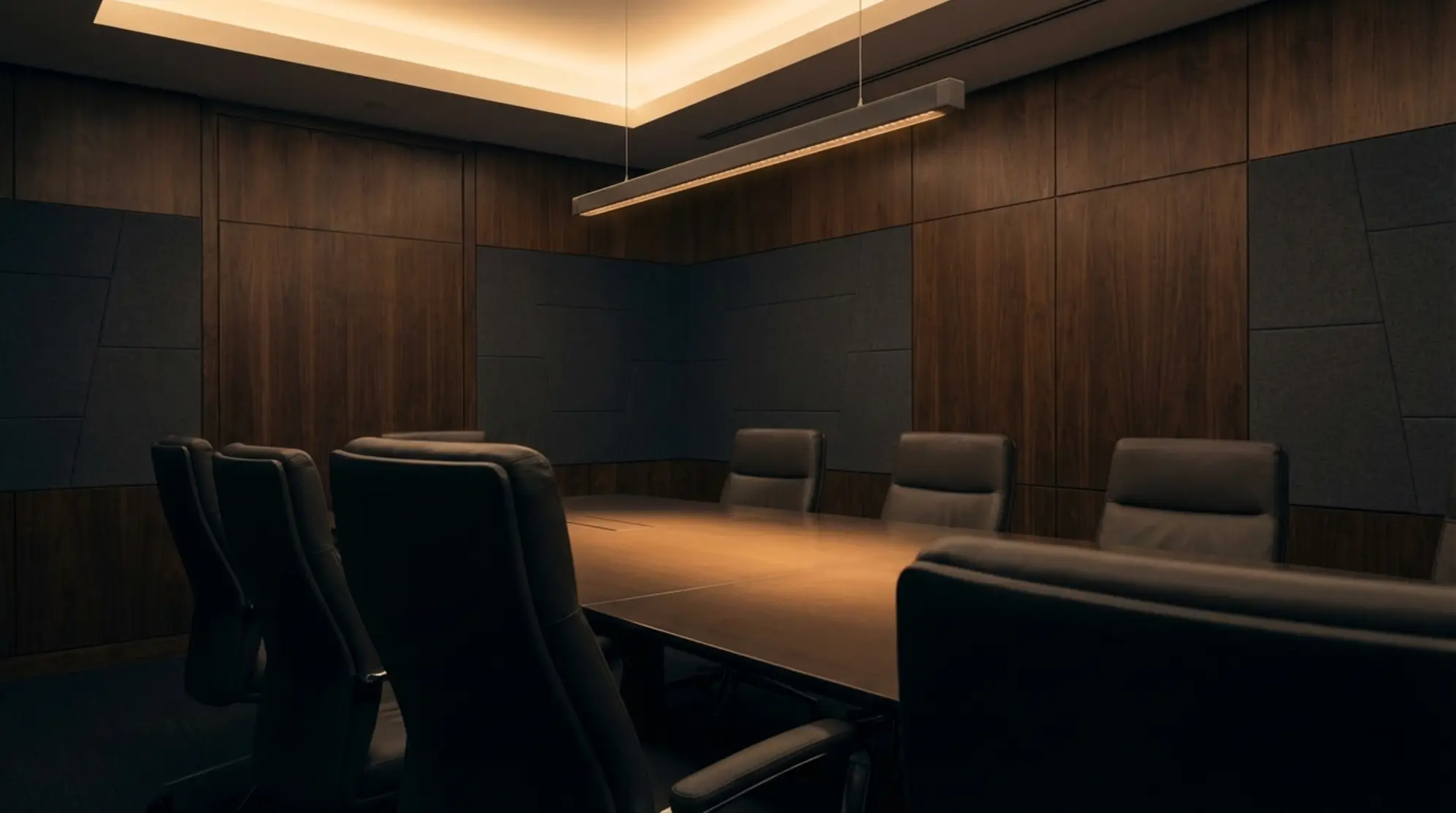
In today's fast-paced business and educational landscapes, clear communication isn't just a luxury, it's the backbone of productivity and successful collaboration. Yet, many organizations grapple with the persistent problem of "What? Can you repeat that?" in their boardrooms, conference halls, and classrooms. This seemingly minor issue of poor acoustics creates a significant "Productivity Tax," eroding efficiency and engagement. For decision-makers evaluating AV solutions, the challenge isn't just procuring equipment; it's engineering environments where every voice is heard, understood, and crucially, where everyone, especially remote participants, feels equally integrated into the conversation.
At HomeIsTheater, we understand that designing for commercial AV goes far beyond selecting a few acoustic panels. It’s about a holistic approach to speech intelligibility, particularly in the age of hybrid meetings, where the "far-end" experience is as critical as the in-room one.
The Cost of Unclear Communication: A Deeper Look
Poor room acoustics can drastically raise Speech Reception Thresholds (SRT). Research from NIH/NCBI indicates that in noise-heavy environments, voice strain alone can account for a 37–66% variance in intelligibility. Imagine the collective impact this has on internal meetings, client presentations, or critical lectures. This isn't just about discomfort; it’s about tangible losses in productivity, missed opportunities, and the hidden frustration of constantly asking for clarification.
The industry standard for commercial AV demands an STI (Speech Transmission Index) of >0.60 for acceptable clarity. However, for true "meeting equity"—where remote participants are seamlessly part of the discussion—an STI of >0.72 is required (Source: NTi Audio). Most content from high-volume players like Shure or Bose focuses on the physical room. Our approach bridges this critical gap, ensuring that both in-room and remote participants experience uncompromised clarity.
The Three Pillars of Acoustic Excellence in Commercial AV
Achieving superior speech intelligibility demands a multi-faceted approach, combining traditional acoustic treatments with cutting-edge active and digital solutions.
1. Passive Solutions: The Foundation of Good Acoustics
This is the "classic" approach, focusing on controlling sound within the physical space. These are indispensable for managing reverberation and echo.
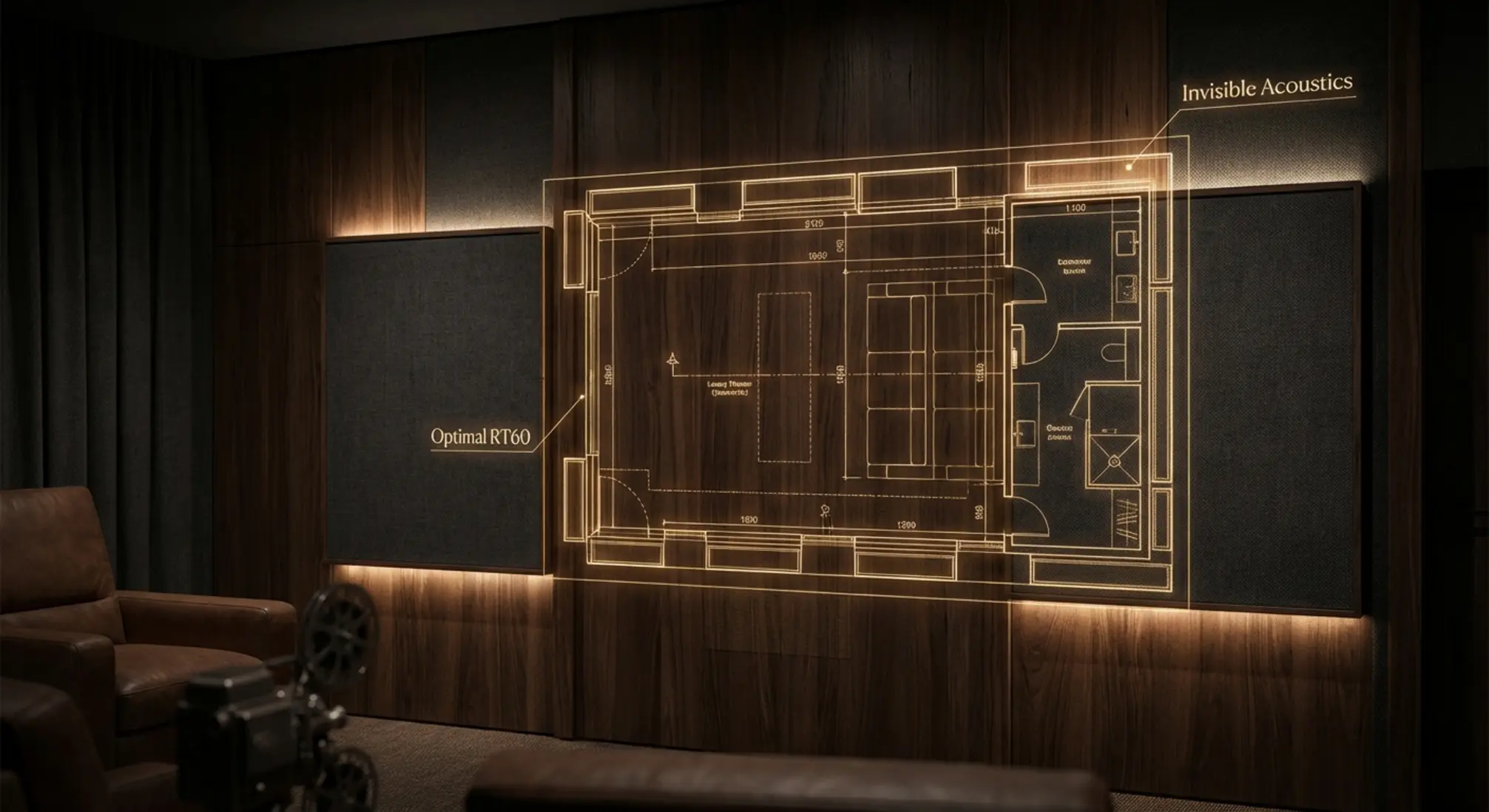
- Acoustic Panels: Made from sound-absorbing materials, these reduce reflections off hard surfaces like walls and ceilings. Strategically placed, they can dramatically lower reverberation time.
- Clouds and Baffles: Suspended from ceilings, these offer absorption for ceiling reflections and can be aesthetic elements in a room.
- Diffusers: Unlike absorbers, diffusers scatter sound waves, preventing harsh echoes and providing a more natural, uniform sound field, especially vital for larger spaces like auditoriums.
2. Active Solutions: Enhancing Speech and Mitigating Noise
Beyond passive treatments, active systems can dynamically manage sound.
- Sound Masking: Introducing low-level, unobtrusive background sound to cover up distracting speech in open-plan offices. This can significantly improve speech privacy and reduce distractions, leading to better focus.
- Voice Lift Systems: In larger venues, voice lift systems use microphones, DSPs, and strategically placed loudspeakers to subtly reinforce a speaker's voice, ensuring it reaches all corners of a large room without sounding amplified.
3. Digital Solutions: The Modern Frontier of Clarity
The advent of AI and advanced Digital Signal Processing (DSP) has revolutionized how we address acoustic challenges, offering solutions that can complement or even reduce the need for extensive physical modifications. This is where the concept of "The Hybrid Hybrid" comes into play—merging physical treatment with AI-DSP logic.
- AI-driven Noise Cancellation: Software like Krisp or built-in capabilities in advanced DSPs can filter out background noise (keyboard clicks, HVAC hum) from microphone signals, ensuring only the speaker's voice is transmitted. This is particularly transformative for the remote participant's experience.
- Beamforming Microphones: These intelligent microphones focus on sound from specific zones, actively rejecting off-axis noise. This technology allows for greater flexibility in seating arrangements and significantly reduces the pickup of general room ambiance.
- Acoustic Echo Cancellation (AEC): A crucial DSP function that prevents microphone signals from picking up sound from loudspeakers in the same room, eliminating feedback and echo during teleconferences.
Decision Matrix: Pairing Solutions with Room Types
Choosing the right combination of solutions depends heavily on the specific room type, its intended use, and the user load. We believe in providing clear frameworks to help you evaluate your options.
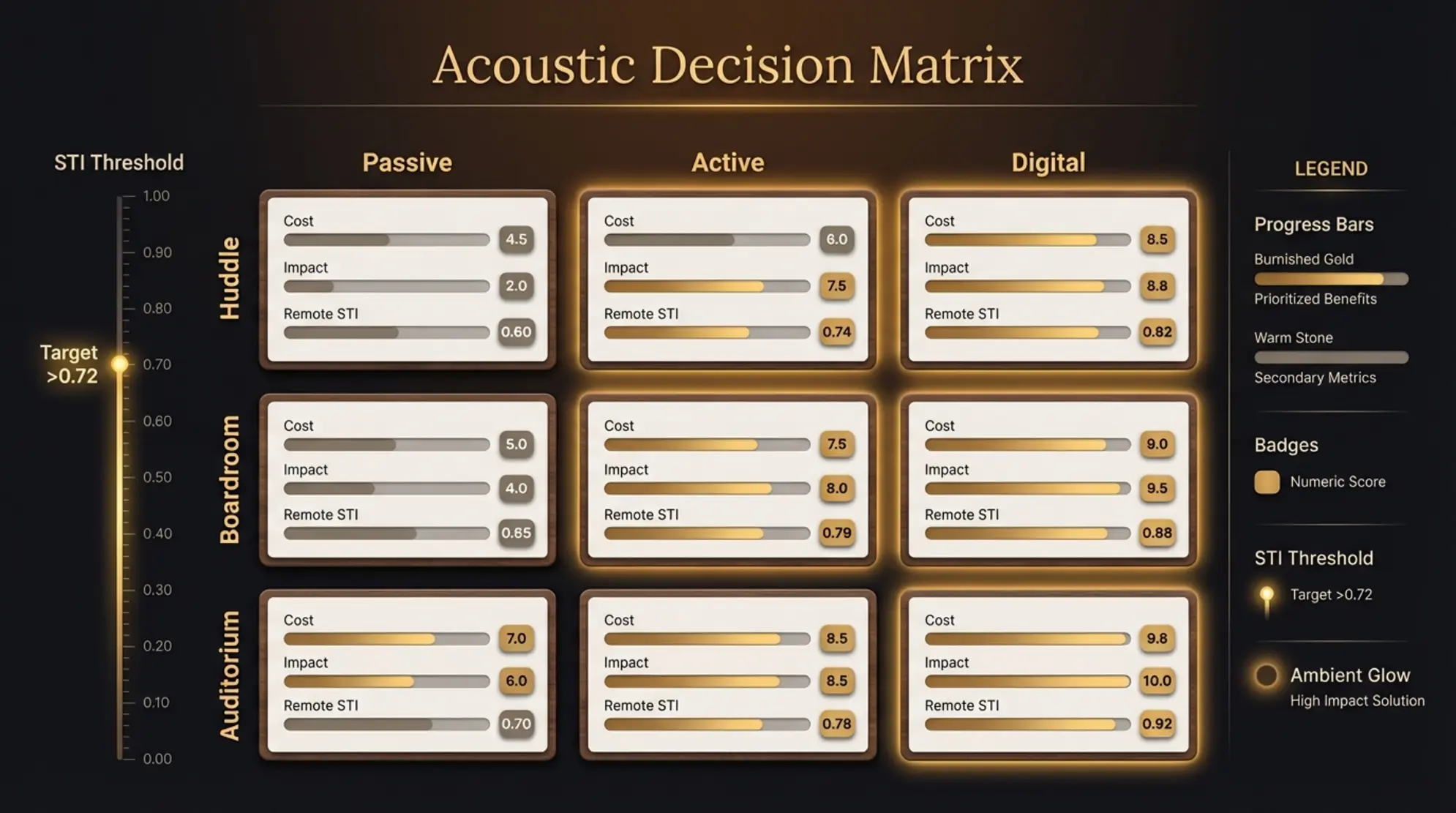
This matrix offers a comparative framework, helping you assess solutions by cost, impact on hybrid meeting equity, and expected STI. It's about moving beyond "Acoustic Panels 101" to a more sophisticated, data-driven decision.
The "Remote Ear" Audit: Measuring Success by the Far-End Experience
One of the biggest oversights in current AV design is the "Far-End" experience. It’s an unstated frustration where remote workers often feel like "second-class citizens" because they can't effectively hear in-room discussions or sidebar conversations. Our unique "Remote Ear" Audit methodology directly addresses this.
We conduct tests not just from within the physical room, but by analyzing how the room acoustics sound to the person not in the room. This involves scientific measurement of the STI from the remote participant's perspective, allowing us to pinpoint specific challenges and validate the effectiveness of our solutions.
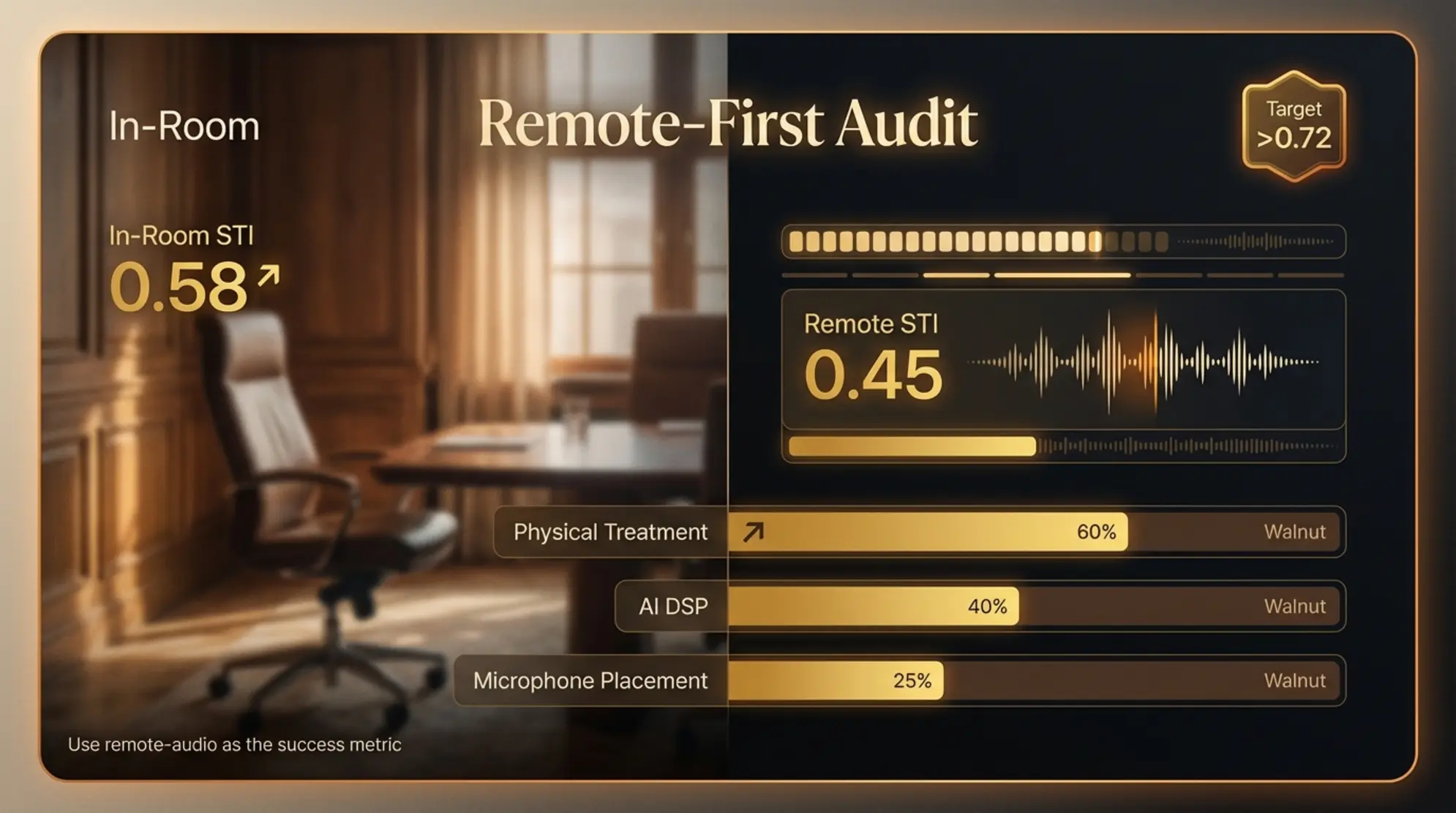
This remote-first design approach is crucial for achieving hybrid meeting equity, where the success of the system is measured by the remote listener's STI. We demonstrate how AI software (like Shure IntelliMix) can reduce the amount of physical padding needed, potentially saving on construction costs while improving digital clarity.
Optimizing Microphone Placement for Unrivaled Clarity
Microphone placement is a critical, yet often underestimated, factor in achieving superior speech intelligibility and feedback reduction. It’s not just about aesthetics; it's about physics and psychology.
Key Considerations for Microphone Placement:
- Proximity: The closer the microphone is to the speaker, the better the signal-to-noise ratio and the clearer the voice pickup. Desktop boundary microphones or ceiling-mounted beamforming arrays address this by effectively "following" the speaker.
- Coverage: Ensure comprehensive coverage of all speaking areas. In a boardroom, this might mean multiple boundary mics; in an auditorium, it could involve specific presenter mics combined with audience pick-up.
- Directionality: Utilizing microphones with specific pick-up patterns (e.g., cardioid, super-cardioid, or beamforming) helps to reject off-axis noise and minimize feedback.
- Feedback Prevention: Placing microphones away from loudspeakers and utilizing advanced Acoustic Echo Cancellation (AEC) in the signal chain are paramount. We meticulously plan microphone and speaker arrays to create an optimal acoustic landscape, as highlighted in our dedicated blog on designing silence.
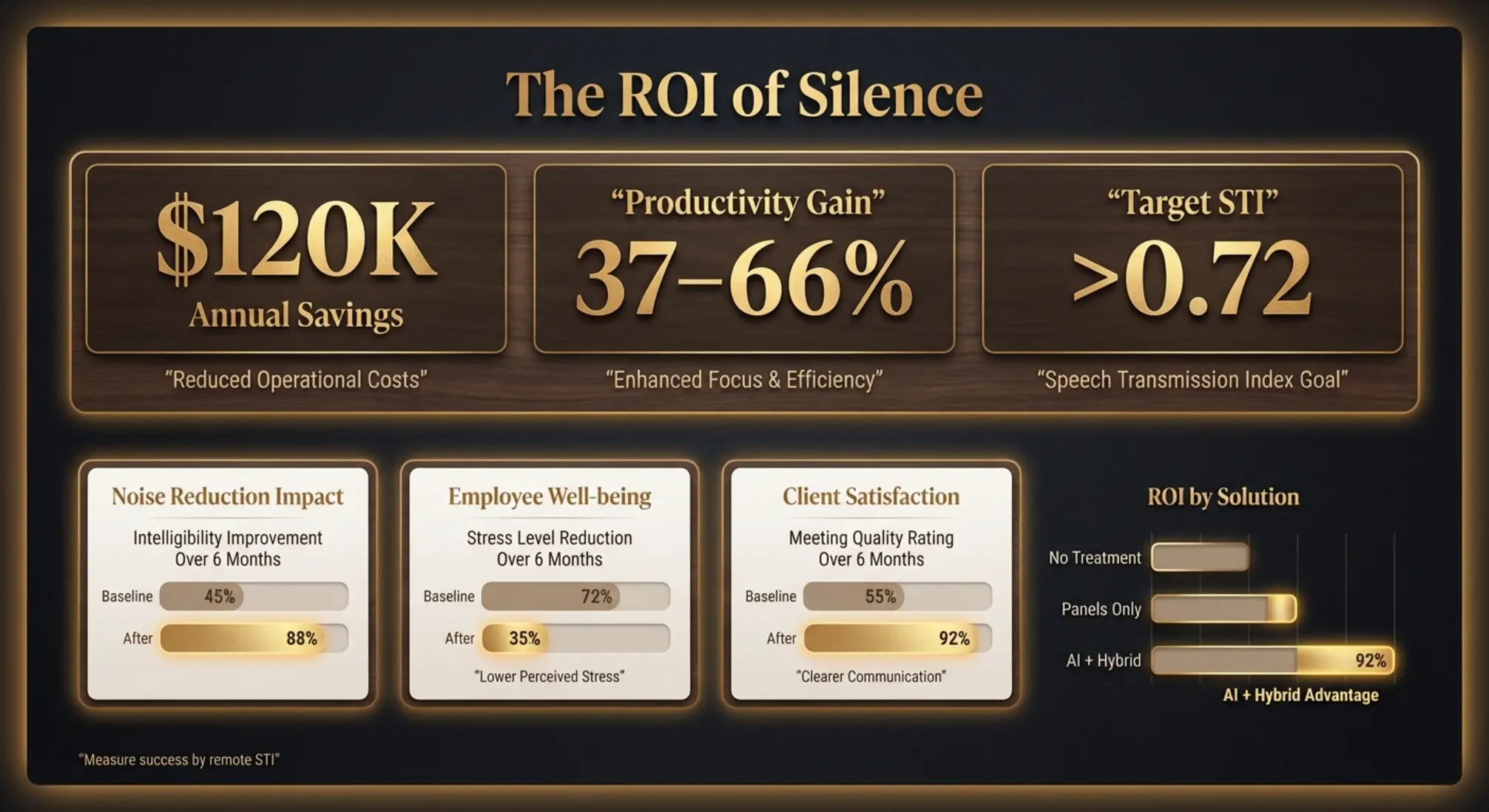
This tactical guide shows how precise microphone placement, particularly with beamforming technology, creates distinct "zones" of audio capture, effectively reducing feedback and optimizing speech pickup. For large spaces, effective in-wall vs. on-wall vs. floorstanding speakers considerations also play a role in directing sound.
The ROI of Superior Acoustics: Justifying Your Investment
Investing in advanced acoustic design isn't just about better sound; it's about improved business outcomes. The "Productivity Tax" from poor audio translates directly into measurable losses. Our approach helps you quantify the ROI of silence.
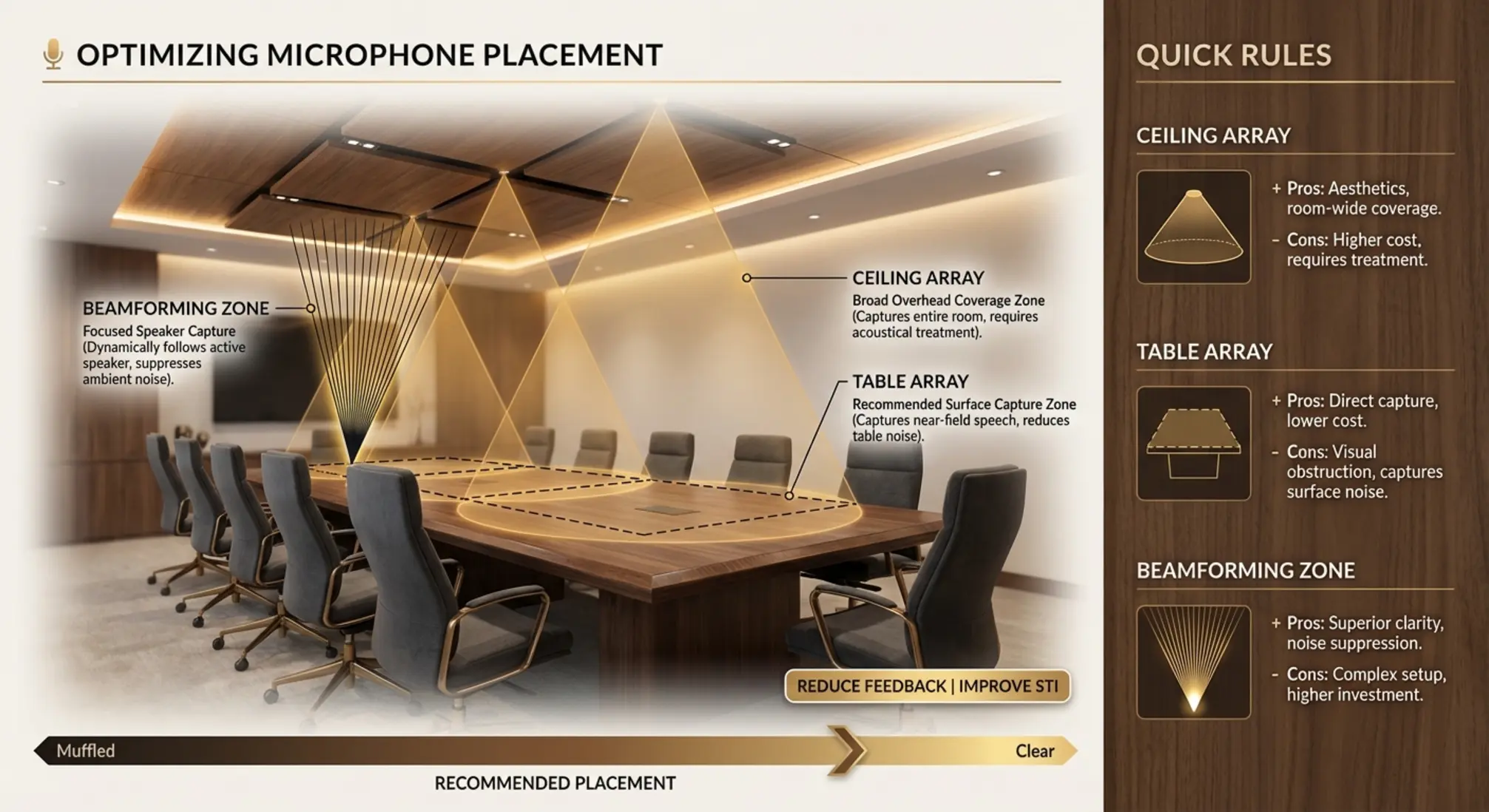
We help translate speech intelligibility improvements into tangible metrics, justifying budget allocation for comprehensive acoustic solutions. By minimizing distractions and enhancing understanding, your organization recoups productivity, boosts decision-making speed, and fosters a more inclusive, engaged workforce. This is a crucial consideration for those evaluating the cost estimates for a premium home theater in Bangalore, applying similar principles to commercial scale.
FAQs: Addressing Your Evaluation Criteria
Q1: How do I know if my existing commercial space has poor acoustics?
A: The most common indicators are excessive echo, difficulty understanding speakers (especially during calls), frequent requests for repetition, and a general sense of fatigue after meetings. A quick way to test is to clap your hands in the room; if you hear distinct reflections that linger, reverberation is likely an issue. For an objective assessment, we perform an Acoustic Site Survey and an STI measurement.
Q2: Is it better to focus on physical acoustic treatments or digital solutions like AI noise cancellation?
A: It's rarely an either/or situation; for optimal results, it's a "Hybrid Hybrid" approach. Physical treatments create a foundational acoustic environment, reducing the overall noise floor and reverberation. Digital solutions then refine the audio, particularly for microphone pickup and far-end clarity, by filtering out remaining distractions and optimizing speech. A well-designed system integrates both for maximum impact.
Q3: What's the typical timeline and investment for improving acoustics in a conference room or auditorium?
A: This varies greatly depending on the room's size, existing materials, and desired STI targets. A small conference room might see improvements from focused treatments and a high-quality beamforming mic within a few weeks and a moderate investment. A large auditorium with structural challenges could take months and a more substantial investment. We provide detailed timelines and cost estimates after our initial consultation and site survey. You can also explore our insights on the perfect home theatre project for an understanding of the detailed planning involved.
Q4: How does acoustic design influence video conferencing and telepresence systems?
A: Acoustic design is paramount for effective video conferencing. Poor room acoustics degrade microphone pickup quality, leading to muffled or echoey audio for remote participants. This disrupts communication and collaboration. Good acoustic design ensures clear voice pickup, minimizes internal room noise, and optimizes the audio transmitted, significantly enhancing the telepresence experience and ensuring everyone can contribute effectively.
Q5: Can HomeIsTheater handle solutions for multiple commercial locations across different cities?
A: Absolutely. While we are based in Bangalore, we serve Tier 1 Indian cities like Delhi, Mumbai, and Hyderabad. Our team has extensive experience designing and implementing bespoke AV solutions for diverse commercial environments, from college auditoriums to corporate boardrooms, often requiring a unified approach across multiple sites.
Q6: What differentiates your acoustic design approach from a standard AV installer?
A: Many AV installers focus solely on equipment installation. Our expertise, honed over two decades, is rooted in the science of sound design and experiential audio. We take a comprehensive approach, meticulously analyzing room dynamics, materials, and usage patterns. We don't just sell products; we engineer complete acoustic environments that prioritize speech intelligibility and remote meeting equity, guided by our founder Vishwas's deep knowledge and hands-on experience. This bespoke approach is why clients trust us for tailored solutions like home automation and commercial AV.
Take the Next Step Towards Perfect Clarity
The transition from "audio-as-an-amenity" to "audio-as-infrastructure" is complete. Your commercial space deserves an acoustic design that supports seamless communication and fosters true meeting equity. Don't let poor acoustics be the silent drain on your organization's productivity.
As an expert in commercial audiovisual solutions, HomeIsTheater is ready to partner with you. Let us help you engineer an environment where every word counts.
Ready to transform your commercial spaces? Contact us for a detailed consultation and let's craft an acoustic solution that elevates your communication to the next level.